Golf has never been short on tradition—but for decades it has struggled with the same question: how do you make the sport faster, more engaging, and more accessible to a modern audience without losing its competitive integrity?
That question is at the heart of TGL—short for Tomorrow’s Golf League—a tech-infused, indoor competition co-founded by Tiger Woods and Rory McIlroy through their company TMRW Sports, in partnership with the PGA Tour.
Launched in 2025 after a one-year delay caused by hurricane damage at its venue, TGL represents one of the most radical reimaginings of professional golf ever attempted. And whether fans ultimately embrace it or not, its influence on the future of the sport is undeniable.
What TGL Is Trying to Solve
Traditional professional golf faces structural challenges:
- Rounds that last five hours or more
- Limited television pacing and long stretches without action
- A demographic skewing older
- Difficulty translating in-person excitement to broadcast
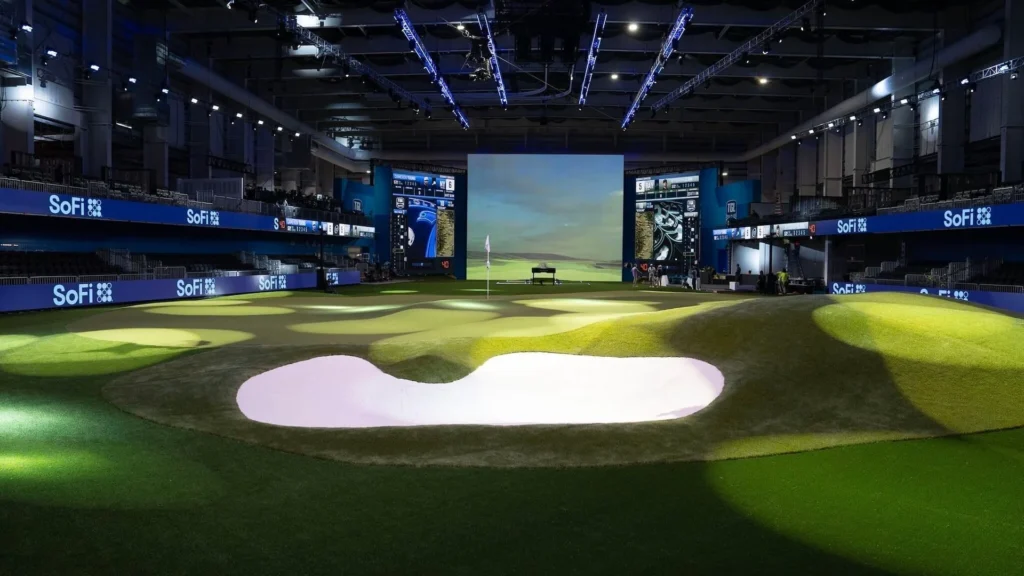
TGL was designed to address these issues directly. Instead of outdoor courses and sprawling layouts, matches take place in a purpose-built indoor arena—the SoFi Center—a 250,000-square-foot venue seating roughly 1,500 fans, built specifically for television and live energy.
The goal isn’t to replace traditional golf. It’s to complement it, offering a fast, primetime product that fits modern viewing habits.
How TGL Actually Works
TGL matches are two-hour, head-to-head team competitions, blending real shots with virtual environments.
The Playing Surface
- Long shots are hit into a massive 64×46-foot simulator screen, simulating holes up to 540 yards
- Short game and putting take place on a rotating, shape-shifting green complex measuring 97×41 feet, powered by more than 600 actuators that alter slope, speed, and contours
This hybrid setup allows players to hit real golf shots while competing on digitally designed holes that would be impossible outdoors.
Match Format and Rules
Each match consists of 15 holes, split into two distinct phases:
1. Triples (Alternate Shot)
- 9 holes
- Teams of three rotate shots
- Emphasizes strategy, chemistry, and decision-making
2. Singles
- 6 holes
- Head-to-head individual matchups
Scoring is simple:
- 1 point for a hole win
- 0.5 points for a tie
- Overtime if the match ends tied
To maintain pace and pressure, TGL uses:
- A 40-second shot clock
- Strategic “Hammer” power-ups that can raise the value of a hole
- A Ref Cam for transparency and fan engagement
The result feels closer to a blend of golf, match play, and esports than a traditional tournament.
Teams, Cities, and Star Power
TGL launched with six city-based teams, each featuring four PGA Tour players (three compete in each match). Ownership groups are intentionally high-profile, borrowing from the NBA and MLS model.
TGL Teams (as of January 2026)
- Atlanta Drive GC – Justin Thomas, Patrick Cantlay, Billy Horschel, Lucas Glover
- Boston Common Golf – Rory McIlroy, Hideki Matsuyama, Keegan Bradley, Adam Scott
- Jupiter Links GC – Tiger Woods, Max Homa, Tom Kim, Kevin Kisner
- Los Angeles Golf Club – Collin Morikawa, Sahith Theegala, Justin Rose, Tommy Fleetwood
- New York Golf Club – Xander Schauffele, Matt Fitzpatrick, Rickie Fowler, Cameron Young
- The Bay Golf Club – Ludvig Åberg, Wyndham Clark, Min Woo Lee, Shane Lowry
The league has already announced expansion, with Motor City Golf Club (Detroit) set to join in 2027, signaling long-term ambition beyond a novelty season.
Season 2: Momentum and Reality Check
The inaugural 2025 season was widely viewed as a success:
- $15–24 million in sponsorship revenue
- Average viewership around 500,000 per match
- Strong performance in the 18–49 demographic
- Sold-out crowds inside the SoFi Center
Season 2 (2025–26) has continued that momentum while also revealing challenges. While viewership remains competitive with many traditional golf broadcasts, it has dipped year-over-year, particularly in matches without Tiger Woods playing a full role.
This has reinforced an early lesson: star participation matters, and TGL’s long-term health will depend on consistent buy-in from its biggest names amid busy PGA Tour schedules.
Is TGL a Response to LIV Golf?
Early criticism framed TGL as a defensive response to LIV Golf’s rise. In reality, the two serve very different purposes.
- LIV disrupts where and how tournaments are played
- TGL disrupts how golf is presented and consumed
Rather than competing directly with LIV or the PGA Tour, TGL positions itself as a winter primetime product, filling a gap in the golf calendar and offering something entirely new.
Why TGL Matters—Even If You Don’t Love It
TGL isn’t meant to feel like Augusta National or a Sunday major finish. It’s meant to feel different.
Its importance lies in what it proves:
- Golf can be shorter without losing competitiveness
- Technology can enhance strategy, not replace skill
- Team formats can work at the highest level
- Younger audiences will engage if presentation evolves
Even if TGL never becomes golf’s primary attraction, its influence on broadcast design, data integration, and fan interaction is likely to shape the sport for years.
The Bottom Line
TGL is golf’s boldest experiment in decades. It blends elite players, cutting-edge technology, team competition, and entertainment into a product designed for modern audiences.
It won’t replace traditional golf—and it doesn’t need to. Its success will be measured by whether it expands the sport’s reach, not whether it looks like the past.
And in that sense, TGL may already be doing exactly what it set out to do: pushing golf forward, one calculated risk at a time.
As always, thank you for reading, we hope you enjoyed this blog!
If you did, please give us a follow on Facebook | Instagram | X
We want to thank our sponsor who inspired, mentored, and guided us along the way as we were getting Tee Time Tavern of the ground. If you need any business advice or mentorship, you need to check out Jimmy Ralph!